
If you maintain a fleet of diesel-powered aerial work platforms, you already know which components command your attention — hydraulic pumps, drive motors, control boxes. But there is a small, unglamorous part bolted to the side of your Deutz engine that can bring a perfectly maintained machine to a complete standstill: the fuel shutoff solenoid.
On Deutz 1011 and 2011 series engines — the powerplants found in countless Genie rough-terrain scissor lifts, JLG boom lifts, and Snorkel articulating platforms — the fuel shutoff solenoid (Deutz part numbers 04103812 and 04103808) is the electromechanical gatekeeper that controls fuel delivery to the injection pump. When it works, you never think about it. When it fails, your engine either will not start, or will not shut down. Either scenario means downtime, and downtime on a 60-foot boom lift at a busy construction site costs far more than the solenoid itself.
For fleet managers and independent service centers looking to control maintenance costs without compromising reliability, understanding this component — and making informed sourcing decisions — deserves a place in your procurement playbook.
The Role of the 04103812 Solenoid: Small Part, Critical Function
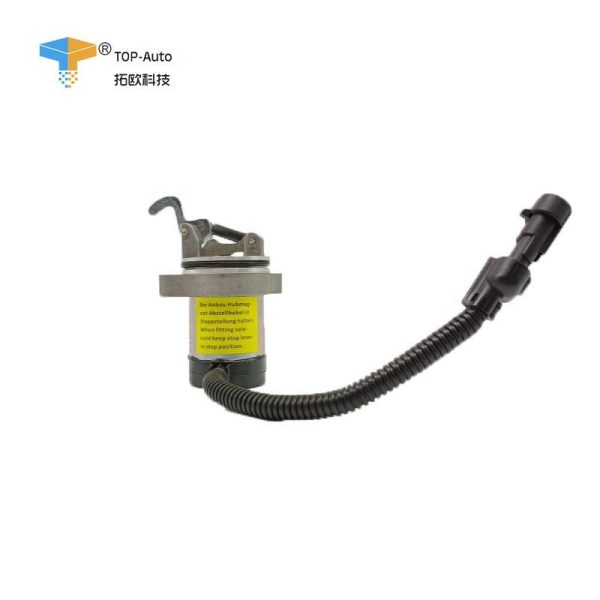
The fuel shutoff solenoid on Deutz 1011 and 2011 engines is a 12VDC electromechanical valve that controls the flow of fuel from the supply line to the injection pump. When you turn the key to the “on” position, the solenoid energizes and retracts a plunger, opening the fuel passage and allowing the engine to start and run. When you turn the key off, the solenoid de-energizes, and an internal spring forces the plunger forward, cutting off fuel flow and stopping the engine.
This solenoid is used across a remarkably broad range of Deutz-powered equipment. The F3L, F4L, F3M, and F4M variants of the 1011 and 2011 engine families power Genie GS-2668 RT and GS-3268 RT rough-terrain scissor lifts, Genie Z-45/22 and Z-45/25J bi-energy boom lifts, and JLG 40H, 450A, 510AJ, and 80HX+6 articulating boom lifts, among many others. These machines operate in demanding environments — dusty construction sites, quarries, and industrial facilities — where engine components are subjected to vibration, temperature extremes, and contamination.
What separates the Deutz 1011/2011 solenoid from generic stop solenoids is its design as an electronic shutoff (ESO) unit. The solenoid must withstand continuous duty cycles — staying energized for hours while the engine runs — without overheating or losing holding force. This thermal endurance requirement is precisely where lower-quality aftermarket solenoids fall short: they may function correctly for the first few weeks, only to degrade under sustained operating temperatures, leading to intermittent no-start conditions or unexpected engine shutdowns that are notoriously difficult to diagnose in the field.
Recognizing the Warning Signs: When Your 04103812 Is Failing
Fuel shutoff solenoid failures rarely occur without warning. Experienced equipment managers and service technicians learn to recognize the symptoms early, allowing planned replacement during scheduled maintenance windows rather than emergency repairs on active job sites.
The most common symptoms indicating the 04103812 solenoid needs attention include:
- Engine cranks but will not start: The solenoid has failed in the closed position, preventing fuel from reaching the injection pump. This is the most common failure mode and the one most likely to strand equipment on-site.
- Engine will not shut down with the key: The solenoid plunger has stuck in the open position, allowing fuel to continue flowing even after power is removed. This is a safety concern that requires immediate attention.
- Intermittent starting problems: The solenoid energizes inconsistently — sometimes the engine fires up immediately, other times repeated key cycles are required. This often indicates internal coil degradation or worn plunger components.
- Clicking sound from the solenoid area when turning the key: A rapid clicking noise suggests the solenoid is receiving power but cannot maintain the energized position, typically due to internal mechanical binding or a failing hold coil.
- Blown fuses related to the engine control circuit: A failing solenoid can draw excessive current as internal resistance increases, potentially blowing fuses and complicating the diagnosis.
If any of these symptoms appear, the fuel shutoff solenoid should be inspected immediately. Continuing to operate with a failing solenoid risks being stranded at height or unable to start the machine for repositioning — scenarios that create both safety hazards and operational delays.
The OEM vs. Aftermarket Dilemma: Why the “Cheap Solenoid” Fails Twice
The market for Deutz fuel shutoff solenoids presents fleet managers with a genuine dilemma. At one end of the spectrum, a genuine Deutz OEM solenoid purchased through an authorized dealer can cost several hundred dollars — one equipment owner on an industry forum reported a dealer quote near 500forasingleunit,whileanothertechnicianmentionedreplacementcostsaround200. At the other end, generic aftermarket solenoids can be found for a fraction of that price, but the industry consensus on these budget alternatives is clear and cautionary.
Foley Engines, a widely recognized authority on Deutz engine service, has explicitly warned against installing non-genuine electronic shutoff solenoids, stating in multiple technical publications that aftermarket units “are cheaply built, will tend to overheat, and will fail”. This is not marketing rhetoric — it reflects a real engineering distinction. The Deutz ESO solenoid is a continuous-duty component that must dissipate heat effectively while maintaining precise plunger positioning against spring pressure. Solenoids built with undersized copper windings, inferior insulation materials, or imprecise plunger tolerances cannot sustain this thermal load over thousands of operating hours.
However, the market has evolved. The false choice — “pay 500forOEMorriska500forOEMorriska40 generic that will fail in three weeks” — is no longer the only option. A new category of engineered aftermarket solenoids has emerged, built to match OEM specifications using comparable-grade copper windings, corrosion-resistant housings, and precision-machined plungers, offered at a price point that makes fleet-wide maintenance programs economically viable.
The Deutz 04103812 Fuel Shutoff Solenoid available from Changsha Top-Auto Technology Co., Ltd. belongs to this engineered aftermarket category. Each unit is produced to 1:1 OEM specifications, undergoes 100% outgoing functional testing, and is backed by a one-year warranty with video inspection available upon request.
Cross-Reference Compatibility: One Solenoid, Dozens of Machines
One of the most practical advantages of the 04103812 solenoid is its broad cross-reference compatibility. This single part number replaces multiple Deutz OEM part numbers and fits an extensive range of engine variants.
This solenoid replaces Deutz part numbers:
04103812, 04103808, 04287583, 04272358, 04270581, 04287116, 04105390, 04103816
Compatible Deutz engine models include:
F3L1011, F3L1011F, F4L1011, F4L1011F, F3M1011, F3M1011F, F4M1011, F4M1011F, F2L1011, F2L1011F, BF4L1011, BF4M1011, BF3L1011, F3L2011, F4L2011, F3M2011, F4M2011, BF4L2011, BF4M2011, BF3L2011, D2011L02, D2011L03, D2011L04, TD2011, TCD2011, and more.
Cross-references to aerial lift OEM part numbers include:
Genie T114678 and JLG 7027251 — the same solenoid used across both major AWP brands.
For fleet managers operating mixed-brand equipment, this cross-compatibility significantly simplifies spare parts inventory. One solenoid part number covers Genie rough-terrain scissors, JLG articulating booms, and any other Deutz 1011/2011-powered equipment in the fleet.
Installation Best Practices: Getting the Most from Your Replacement Solenoid
Replacing the fuel shutoff solenoid is a straightforward procedure for qualified technicians, but following these best practices helps maximize service life and prevent premature failure:
- Verify you have the correct solenoid style. Deutz 1011/2011 engines use two styles of solenoids. The early style features a three-pronged connector and requires an adapter harness. The late style uses a two-wire pigtail connection. The Top-Auto 04103812 solenoid is compatible with both styles; if you have the early three-pronged type, ensure you retain or source the correct adapter harness.
- Confirm you actually need a solenoid, not an actuator. Certain 1011F and 2011 series engines — particularly those powering JLG equipment — utilize a fuel actuator rather than a standard shutoff solenoid. The actuator serves a similar function but is a different component with different part numbers. Before ordering, visually compare your existing unit to the product images to ensure correct fitment.
- Disconnect battery power before starting work. This prevents accidental short circuits during removal and installation.
- Clean the mounting area thoroughly. Debris entering the governor housing during solenoid replacement can cause internal engine damage. Wipe down the surrounding area before removing the old solenoid.
- Inspect the wiring harness. A compromised power supply — corroded connectors, damaged insulation, or loose terminals — can cause the new solenoid to underperform or fail prematurely.
- Test before returning to service. After installation, cycle the key switch several times to verify the solenoid energizes consistently and the engine starts and stops as expected. Listen for a clean, single click — not a rapid chattering — when the key is turned to the “on” position.