
Meta Description: Discover why snakewood nunchaku command near-thousand-dollar price tags among collectors and martial artists worldwide. One of the hardest woods on earth, every pair wears a unique biological signature that no factory can replicate. Here‘s what makes this wood worth the investment — and how to care for yours.
Most martial arts weapons are tools. When you outgrow them, you set them aside. A snakewood nunchaku doesn’t work that way. It is one of the few objects in the martial arts world that genuinely improves with age — growing richer in color, developing deeper luster, and accumulating personal history with every practice session. What starts as a striking training implement gradually transforms into something rarer: a legitimate heirloom.
The Snakewood Nunchaku represents the intersection where functional martial arts weaponry meets collectible exotic wood artistry. At prices ranging from 280to978 per pair, these are not entry-level training tools. They are investment-grade pieces for practitioners and collectors who understand exactly what they are holding.
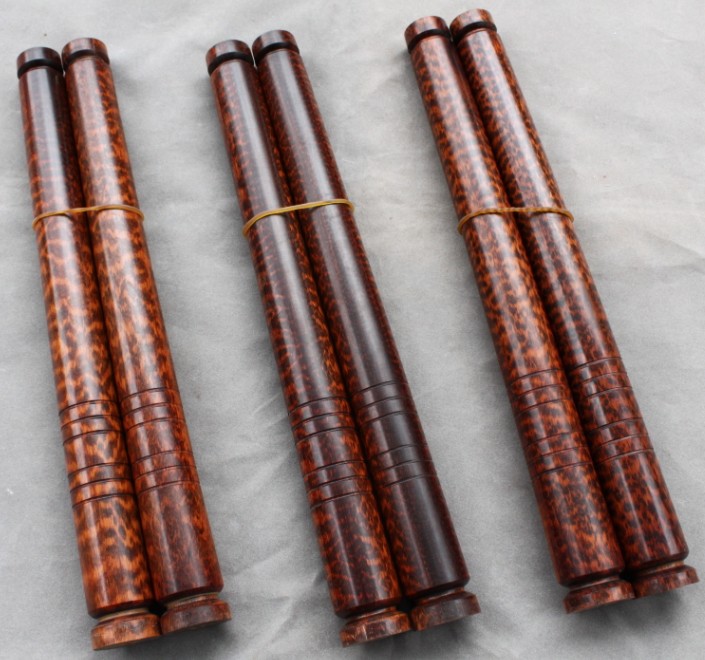
A Wood That Sinks in Water — and Other Reasons Snakewood Commands Respect
Before discussing nunchaku specifically, you need to understand the material itself. Snakewood (Piratinera guianensis), also known as Letterwood or Leopardwood, originates in the tropical rainforests of Suriname, Guyana, and neighboring regions of South America. The tree is not commercially farmed. It grows slowly in the wild, typically as an understory species beneath the rainforest canopy, and yields surprisingly little usable heartwood even from a mature trunk. A tree with a diameter of 50 cm (approximately 20 inches) may contain an inner core of the prized dark heartwood only 18 cm (approximately 7 inches) across. The commercial heartwood yield from a typical log is around 10% — meaning 90% of what gets cut simply cannot be used.
This scarcity fundamentally shapes how snakewood products reach the market. Prices for raw snakewood are quoted per kilogram — not per board foot — and routinely exceed $100 per kg on international markets, putting it in a league occupied by very few wood species on earth. Snakewood nunchaku are not mass-produced items. The shop explicitly states this: the scrap rate during manufacturing is so high, and the pattern results so unpredictable, that producing these in bulk is simply not feasible. Each pair is made individually, and the final price is determined almost entirely by the quality and intensity of the snakeskin-like figuring visible on the finished sticks.
Physical Properties at a Glance
These are not abstract numbers. They translate directly into the nunchaku in your hands: a weapon with heft, density, and impact resistance that lighter woods simply cannot match. When you swing a snakewood nunchaku, you feel the mass transfer through each rotation in a way that lighter training tools never deliver — with a specific gravity above 1.2, the wood sinks in water, a visceral reminder of its extraordinary density.
The Pricing System: Why One Pair Costs More Than Another
One of the most unusual — and honestly, refreshing — aspects of this product listing is its transparency. The shop displays seven separate price tiers for the same model, ranging from 280to978, and explains exactly why: prices are mainly determined by the beauty of the snake pattern.
This is a remarkable way to sell nunchaku. Most retailers would grade their inventory privately and charge a flat rate. Instead, this shop provides high-resolution photos of each individual pair (available at 5000×5000 pixels upon request before purchase) and lets the buyer decide what level of figuring justifies the price. Three pairs at the top tier (850−978) display the most pronounced, swirling snakeskin markings. Four mid-tier pairs fall between 350and699. Entry-level pairs at 280−350 still deliver authentic snakewood, just with less dramatic grain patterns.
For the collector, this pricing model is a feature, not a flaw. It means you can enter at whatever level your budget and aesthetic preferences allow, and you know exactly what you are paying for. Several pairs have already sold out as of this writing — a reflection of how quickly individual sticks move when each one is fundamentally one-of-a-kind.
The Natural Oxidation Journey: Color That Deepens Over Decades
One of the most compelling reasons to invest in a high-quality snakewood piece like this nunchaku is how the wood transforms over decades of ownership. Snakewood is photochromic — its vibrant reddish-orange tones gradually deepen into a rich, dark maroon patina as the wood oxidizes over months and years. This is not rapid fading or degradation; it’s a slow, graceful maturation where the contrast between the dark figuring and the background wood becomes richer and more dramatic.
This natural oxidation process is a living timeline. A snakewood nunchaku that looks vibrant and red when first purchased will, after several years, settle into a deeper, more subdued elegance. The “snakeskin” grain pattern that initially appeared as high-contrast black markings against orange-brown will evolve into something more subtle and complex. Every change is driven by the wood’s chemistry, not by artificial stains or chemical treatments.
What this means in practical terms: if you purchase a snakewood nunchaku with lighter, more vibrant tones today, you are not just buying a weapon. You are witnessing the beginning of a decades-long aging journey that will play out in parallel with your own martial arts practice. The nunchaku your grandchildren see will look noticeably different — and arguably more beautiful — than the one you unboxed.
Natural Luster and Grip: Why Snakewood Feels Different in Your Hands
Beyond its visual appeal, snakewood possesses one practical quality that directly benefits nunchaku handling: it is naturally oily and self-lubricating. Unlike finished hardwoods that require synthetic lacquers, varnishes, or oils to achieve a smooth surface, snakewood can be polished directly to a glass-like finish without any coating at all. The wood‘s own natural oils rise to the surface, creating a smooth, almost waxy feel that provides secure grip without becoming tacky or slippery — even during extended practice sessions.
This matters for nunchaku in a way it does not for passive collectibles like pens or knife handles. A display piece sits on a shelf. A nunchaku gets spun, flipped, caught, and occasionally dropped. The surface needs to feel right in motion — not just look right in photos. Many mass-produced nunchaku feature glossy synthetic finishes that look appealing in product photography but become dangerously slick after a few minutes of sweaty practice. Snakewood’s natural finish avoids this problem entirely. The grip is tactile without being abrasive, smooth without being slippery.
Snakewood Across Industries: What Other Premium Applications Reveal
To understand why snakewood commands such high prices, it helps to look at what else this wood is used for across premium industries:
- Fine violin bows: Snakewood is considered the finest material in the world for Baroque violin bows. A single French-made bass bow crafted from snakewood with silver inlay sells for over $3,100.
- Luxury knives: William Henry Knives, one of America‘s most prestigious custom knife companies, produces limited-edition snakewood handle knives annually. A single 7.4-inch folding knife retails globally for $700.
- High-end pool cues: Custom cue makers prize snakewood for its weight, density, and stability — properties equally valued in nunchaku construction.
- Luxury walking canes: In Japan and Korea, snakewood is known as the “diamond of woods.” A standard snakewood cane retails for approximately ¥400,000 (roughly 2,500USD)inJapan,withmodelsfeaturingivoryorpreciousmetalinlayexceeding¥1,000,000(roughly6,500 USD). Korean buyers are equally willing to pay premium prices for this material’s unique patterning, and European and American collectors have long recognized its rarity.
- Golf putter inserts: Some premium golf club manufacturers use snakewood for putter face inserts, where its density and feel provide unique feedback on impact.
The common thread: snakewood shows up wherever density, durability, and distinctive appearance justify a premium price. Nunchaku are simply another application where all three qualities converge — and arguably one where they matter most, given the impacts and handling demands the weapon endures.
Care and Maintenance: Protecting Your Investment
Snakewood has a reputation among woodworkers for being temperamental — specifically, prone to surface checking (fine cracks) when exposed to rapid temperature or humidity changes. This is not a manufacturing defect. It is a characteristic of extremely dense tropical hardwoods, and it is well-documented in specialty woodworking communities.
The good news: with basic precautions, snakewood nunchaku will remain stable for decades. The rules are simple:
- Avoid extreme temperature swings. Do not leave your nunchaku in a hot car during summer, then bring them into an air-conditioned room. The sudden change stresses the wood and can cause surface checks to develop. Storage should be at a constant, moderate temperature.
- Keep them dry but not desiccated. Snakewood is highly rot-resistant due to its density and natural oils, but it is still wood. If the nunchaku get wet during outdoor practice, wipe them down promptly. Conversely, storing them in an excessively dry environment (such as directly next to a heating vent) for extended periods can draw out too much moisture and encourage cracking.
- Minimal oiling. Unlike many exotic hardwoods that require regular oiling to prevent drying out, snakewood‘s natural oil content is so high that supplemental oiling is rarely needed. If the surface begins to look dull after months or years of use, apply the lightest possible coat of pure tung oil or lemon oil — a few drops on a soft cloth is sufficient. Wipe off all excess after 15–20 minutes. Over-oiling can darken the wood unevenly and accelerate the oxidation process beyond what some owners prefer. When in doubt, less is more.
- Respect the value. Multiple nunchaku builders and collectors in martial arts forums independently arrive at the same conclusion: snakewood nunchaku are too precious to be daily beaters. One craftsman, upon completing his own hand-made pair, wrote simply: “The snakewood nunchucks are finished. Now I hesitate to use them freely — it feels like a waste of such fine material.” His solution was to build a secondary pair out of white wax wood for everyday training, reserving the snakewood for special practice sessions and display. This is a sensible approach. Use your snakewood nunchaku. Enjoy them. But keep a less expensive practice pair for rough drills, outdoor sessions, and situations where dings are expected.
- Watch for skin sensitivity. A small percentage of individuals may experience skin irritation from contact with snakewood dust or prolonged handling of the raw wood. This is rarely an issue with finished, polished pieces, but worth noting for those with known sensitivities to exotic hardwoods.
A note on “survival rate”: Among woodworkers, there is a saying that the average snakewood piece has less than a 50% chance of surviving the drying and working process without developing at least some checking. This refers primarily to thin, large-surface-area pieces like guitar backs or veneer sheets — not to dense, cylindrical objects like nunchaku sticks. Properly turned and finished nunchaku are inherently more stable due to their shape and thickness. The reputation for fragility is somewhat overstated for this specific application, but it underscores why careful temperature management is worth taking seriously.
Snakewood vs. Other Exotic Hardwoods
The exotic nunchaku market features several premium woods. Here’s how snakewood compares:
| Feature | Snakewood | Cocobolo | Ebony | Ironwood |
|---|---|---|---|---|
| Density | Extremely high (sinks) | High | High | Extremely high |
| Grain Pattern | Intricate snakeskin/letter pattern | Swirling orange-red with black | Uniform dark brown-black | Subtle figuring |
| Janka Hardness | 3,800 lbf | ~2,960 lbf | ~3,220 lbf | ~3,260 lbf |
| Natural Luster | Very high — polishes to glass finish | Medium-high | Medium | Medium |
| Oxidation | Deepens dramatically to maroon over decades | Darkens significantly | Minimal change | Minimal change |
| Cracking Risk | Higher — requires careful temperature control | Low | Medium | Low |
| Price | Premium — priced per kg raw, highest scrap rate | Premium | Premium | Premium |
Cocobolo offers musicality and rich color. Ebony offers understated elegance. But for sheer visual drama paired with measurable physical performance, snakewood occupies its own category. And for the collector who already owns examples of the other exotic woods, snakewood represents the logical — and arguably inevitable — next acquisition.
The Versatility of Snakewood: From Display Case to Practice Floor
One of the most compelling aspects of owning a snakewood nunchaku is its dual-purpose nature. Unlike a fragile collectible that must remain behind glass, these nunchaku are built for use. The density that makes them visually striking also makes them functionally excellent — the weight distribution, the secure grip, and the impact resistance all contribute to genuine martial arts performance. Yet their aesthetic value means they command attention even when resting on a display stand.
For practitioners who split their time between serious training and serious collecting, this versatility is rare and valuable. You can display your snakewood nunchaku proudly, then take them down for a focused practice session — and they will perform as well as they look. Few martial arts weapons bridge these two worlds so effectively.
The Global Collectible Market: Snakewood as an Investment
The collectible nunchaku market has matured significantly over the past decade. Where once the weapon was primarily viewed through the lens of martial arts utility, a growing community of collectors now evaluates nunchaku through the same criteria applied to premium knives, custom pool cues, and high-end wristwatches: material quality, craftsmanship, rarity, and long-term value preservation.
Snakewood sits at the apex of this market for several converging reasons:
- Raw material scarcity is structural, not cyclical. Snakewood trees require decades to reach harvestable size and are found only in a specific region of South America. Logging is restricted in many areas, and the export supply chain is limited. This is not a commodity where supply can ramp up to meet demand — what exists is what exists.
- Waste rate during manufacturing is extreme. Even for an experienced craftsman, turning snakewood into finished nunchaku involves significant losses due to checking, internal defects, and the need to work around irregular grain patterns. The shop’s explicit acknowledgment of high scrap rates is not marketing language — it is an economic reality that directly constrains how many pairs can be produced in a given batch.
- The grading system rewards the best pieces. By tying price directly to pattern quality, the market naturally elevates the most visually striking pairs to premium valuations. Over time, as the finest examples get absorbed into private collections and become unavailable, the average available quality in the market will trend downward — making existing top-tier pairs even more valuable.
This dynamic mirrors what has happened in other collectible categories: Stratocaster guitars from specific factory years, folding knives from discontinued production runs, mechanical watches with particular dial configurations. Once the supply of the best examples dries up, the market never sees their equal again.
About Nunchaku1-1.net
Nunchaku1-1.net is a specialized retailer of professional-grade nunchaku, serving martial artists and collectors worldwide from a workshop that treats each pair as an individual project rather than a production-line afterthought. The shop’s approach — providing high-resolution photos of each specific pair, pricing transparently by pattern quality, and offering direct customer consultation before purchase — reflects an artisan ethos rather than a mass-retail mindset.
Each snakewood nunchaku ships with a gold dragon embroidered carrying pouch and a spare rope (available in double rope or King Kong knot configuration — an assembly method using cord only without chain or ball bearings). Contact the shop directly for the latest inventory, as individual pairs sell through quickly and availability is always limited to whatever the current batch has produced.
A Final Thought
There is a well-known saying in woodworking circles: snakewood has roughly a 50% survival rate — meaning half of all pieces checked, cracked, or otherwise failed during the drying and working process. The ones that make it through are survivors in the most literal sense. Every snakewood nunchaku you hold has beaten those odds.
That survival story is now yours to continue. With proper care, this nunchaku will not merely last — it will improve, deepening in color and character across decades of ownership. Few possessions in any category — martial arts or otherwise — can make that claim.